Tuesday, January 29, 2013

In the Theater with...Mama

Even though Mama was co-written and directed by Andrés Muschietti, you can feel the influence of executive producer Guillermo del Toro, because del Toro loves nature in its most twisted, bumpy, and gnarled forms. Whether it's tiny twigs, giant tree roots, or anthropomorphic demon-vegetables, if it has an organically uneven texture, this creative genius is all over it.

"Look, my skin condition is covered under the ADA, jerk!"
(note: from another movie)

But this movie isn't all creepy primeval forest. There's also the equally disquieting banality of the American suburbs, which is a perfect counterpoint to all of the dried-out bark textures of nature's dark side. A forest full of creepy trees is creepy, sure, but a token remainder of organic detritus is even creepier when placed in the plastic artificiality of a modern American home. It, like, radically confronts the inauthenticity around it.

Um, so...bath time, then?

Thus we have the strange premise of Mama: two little girls are abandoned by their father in the woods and not seen again for five years, when they are stumbled upon by some half-hearted redneck search and rescuers. It seems they've been hanging around someone's mid-century modern lake cabin all this time, eating cherries and becoming filthy. The opening titles also suggest they've learned to kill raccoons, but we never really get to see any of that.

Home, sweet freaky home

How could young children survive for years on end with only the fruits of the forest to eat and someone's once-chic weekend place for shelter? What unspeakable force was guarding and protecting them all this time? Mama.

They're so cute - they hardly seem like demon possessed monsters at all

After an astonishingly quick program of re-socialization by a smarmy child psychologist (Daniel Kash), they're sent home with their uncle (Nikolaj Coster-Waldau, aka Jaine Lannister) and his non-maternal riot grrrrlfriend (Jessica Chastain, aka Veronica Mars' pregnant neighbor Sarah). The kids' deeply troubled animalistic natures have seemingly been soothed and they're quickly ensconced in a suburban home of suprassing blandness.

Fear of imminent death will bring us together as a family

Naturally, the disturbing force of otherness from the woods doesn't stay quiet for long. It seems the spirit that guarded the girls all those years hasn't given up her custodian duties quite yet. Worse yet, she's jealous - even of Jane Chastain's heroically half-assed version of foster parenting.

Mama, I've got to go...

And here we have the least satisfying part of what has already been a mediocre horror movie. The Mama spirit which is greedily asserting control over the future of the girls and threatening the other characters turns out to be a ghost which is frustratingly multi-modal. She's a smoky wisp one minute, and a corporeal manifestation with classic del Toro gnarled fingers the next. She's protective yet reckless, and playful yet violent almost simultaneously. Seriously, giggling/screeching banshee woman, pick a personality and stick with it.

Are four able-bodied human beings the equal of one twisty-faced mom hag? Maybe.

No spoilers, but the final scenes brings us back to...the creepy forest. Note the naked, twisting limbs behind our friends. The message is clear: don't spend too many years along in the forest, or a perverted Freudian nightmare will get you.

Wednesday, January 23, 2013

In the Theater with...Lincoln

Daniel Day-Lewis can really sell a folksy anecdote about George Washington and English bowel movements, and that is why, along with the sophisticated makeup and hair styling, we believe he is Abraham Lincoln. 


Day-Lewis' Emancipator is kind and wise, but also conniving and practical, and represents some of the better aspects of the America's political system, namely that it tends toward a more just society over time while (usually) refusing to engage in factional fanaticism. In several conversations with other political figures, he steers away from ideological purity and toward a path of practical wisdom.


This focus on Lincoln on a horse-trading politician rather then a martyred saint is especially interesting in for a film released in 2012. Despite widespread cynicism about the ability of national political leaders to get anything desirable accomplished, the movie's story rests in large part in demonstrating how the sausage factory of Washington can be redeemed with lofty goals and hard work. Of course, the movie does depict most of the politicians in 1865 as either spineless, venal, or stupid, but that's how you know it's based on actual history.


Tuesday, January 22, 2013

In the Theater with...Argo

I must confess to never having been particularly impressed with Ben Affleck's movie career. Even in his Academy Award™-winning, break out Good Will Hunting phase, I never felt a connection to him on screen. And it wasn't just legendary dumb scripts like Armageddon (Ar-MEG-uh-don) either. He just didn't seem to have the weight to be a real movie star.


The early years: A boy in man-child's clothing

But now, allow me to reverse course. Affleck's role as the lead in Argo, as well as his job directing, was strong and nuanced and impressive. Forget Smokin' Aces and even Gigli (which, like everyone else, I never saw), because Ben has risen to his material and made an excellent film. Also, his in-film beard is matched for its excellence only by his real-life awards season beard.


The B.A. of today: Give this man another award

Affleck's CIA agent based-on-reality character Tony Mendez manages to bounce between family heartbreak, career uncertainty, and the terror of facing torture and execution with calm determination. If he were from a normal walk of life, this would seem like under-emoting, but as an experienced covert operative it's only part of the life he's chosen. He's concerned and wary, but his past successes give him confidence to face the challenges of hostage-era Tehran without losing his Shiite


Tony Montana, telex your office

Style points for art direction and costuming are awarded for the very late-1970s (actually 1980) feel of the movie. The office typewriters, shaggy hair, big tie knots, and constant smoking evoke a not-too-distant age in which micro computers were the technological rage and citizen band radio was still a major cultural influence.


Him? Never met the guy.

On a related costume/styling note, I was afraid I would be too far under the influence of the legendary Heisenberg to see Bryan Cranston in another light, but a head of (presumably natural) hair and a brown three-piece suit had me under his covert bureaucrat spell.


Where the hell is that kid with my cappuccino!?

Finally, I also liked John Goodman as real-life makeup wizard and sometimes spy sidekick John Chambers, but the dialogue in the Hollywood scenes is a little on the shticky side of Hollywood. The "let's-make-a-fake-movie-to-fool-the-Ayatollah" plan is admittedly wacky, but surely they could have done better than telegraphing a cornball line like this from a mile away: 
John Chambers: [after hearing of the plan to get the hostages out] So you want to come to Hollywood, act like a big shot...
Tony Mendez: Yeah.
John Chambers: ...without actually doing anything?
Tony Mendez: Yeah.
John Chambers: [smiles] You'll fit right in! 
Ba-dum-bum! Take that, vapidity of the entertainment business!

Friday, January 18, 2013

In the Theater with...Django Unchained

Yes, the "D" is silent. Got it. That said, here are a few thoughts about Django Unchained.


1. Is there a white person on earth who loves the n-word more than Quentin Tarantino? Not even the most vile sower of racial hatred could possibly have as avid an affinity for this troublesome word and its strange career. Was he obsessed with Richard Pryor comedy albums as a child?

2. Christoph Waltz is great, and has just enough of an accent to sound interesting without making American audiences uncomfortable that they might not understand what he's saying (despite a character early on demanding that he "speak English!" when his vocabulary proves too erudite for everyday slave-trafficking Americans of 1858).

3. The squib budget on this film must have been astronomical. I suspect the cast entertained themselves during down time with blood-filled whoopie cushions.

4. I admire Tarantino's restraint as a writer in not making Leonardo DiCaprio's character a slave to his lust for his male slaves. I really thought that's what was coming at one point, and it would have created a black hole of emotionally-weighted stereotypes that would have swallowed the film. Whew.

5. The scene with the riders with flour sacks on their heads seemed like a conscious tribute to the style and spirit of Blazing Saddles. I hope it was.

6. At the end of the film, it appears that Samuel L. Jackson's apparently frail, 76-year old character might not be so frail after all. I was imagining a fight between he and Jamie Foxx a la Yoda's sudden explosive energy in Attack of the Clones. Sadly, it was not to be.

7. Speaking of which, Jamie Foxx shots a lot of people in this movie, and it all looks realisticly gory. The moment in which the one female is shot, however, features a theory of physics usually confined to Road Runner cartoons.

8. Biggest disappointment: Kerry Washington as Django's wife is given almost nothing to do. She looks scared, nervous, worried, excited, then scared again. The most physically dynamic thing she does on screen, literally, is fall on the floor. Despite the fact that her future is being determined by a complex scheme to which she is theoretically a party, she has absolutely no role in moving it forward. There just aren't enough good roles out there depicting strong, enslaved black women. Wake up, Hollywood.

Overall I enjoyed it, despite the shower of racial obscenity, the ineffectual German-speaking wives, and the fact that Tarantino cast himself and Jonah Hill in roles that do nothing but distract you from the film. I give it 3 and a half Emancipation Proclamations.

And now, let's refresh ourselves with a song.


Tuesday, January 01, 2013

Istanbul Diary, Day 7

The day started out with breakfast at the hotel, as has quickly become our habit. I have to say, I like the look of my mostly American-style breakfast selections on this morning.


After a hearty breakfast, we decided to shake off the musty shackles of the city's historic sites and explore the contemporary face of Turkish culture with a trip to the Istanbul Modern. Art museum, that it. To start with, it had a pretty fantastic view of the water on a cloudy day.


But that's not why we're here. We're here to see a bracing new vision of what it means to be human in the modern world. And here it is:


Tomás Saraceno80SW Iridescent / Flying Garden / Air‐Port‐City (2007)


Ergin Inan, Self Portrait (1996)


Julian Opie, Ann Dancing in Sequined Dress (2009)


Ekrem Yalcindag, 2313 Mal Rot (2008) detail

That's a close-in photo that's within the original frame of the piece. In case that's not close enough to see the essential detail, please see the smaller detail below. This was one of my favorite pieces on display.


In addition to all of the challenging modern art pieces displayed within, the museum also has a back deck (and cafe) that overlooks the Bosphorus, its shipping traffic, and both sides of the city in stunning detail. Here's Bryan with his museum sticker adding to the beauty of the surroundings. 


Istanbul is full of dramatic new-meets-old visual contrasts. As one exits the Modern, it is impossible not to notice the Baroque-style Nusretiye Mosque built in 1823-1826 by Sultan Mahmut II. This particular mosque has seen better days, but it's on the mend and is currently being renovated.


Farewell, Istanbul Modern; your florid wall text and desperate attempts to be taken seriously by the rest of the contemporary art world will not be forgotten!


Leaving behind the neon light installations set off with mummified monkeys, we strolled down to the monument to the final era of Ottoman opulence, the Dolmabahçe Palace


After centuries of living in the tile-glazed splendor of Topkapi Palace across town, the Imperial family decided that building a modern palace with plumbing and lights was just the ticket. So build they did.


As we were waiting in line to get into the main ceremonial section of the Palace, we noticed that some foolish parent had left their child's stroller unattended. Loaded down, as many strollers are these days, with any manner of food and drink, it was only a matter of time before one of the many cats of Istanbul made a move.


This bold feline strolled right up to the pouch in the back and grabbed the bread right out. And not just any bread, but the distinctive bagel/pretzel/sesame bun bread sold everywhere around Istanbul called simit. Which I way I startled the entire line of impatient palace-goers by shouting out "No kitteh! Simit is not for you!" The cat was startled, but kept at its task.


On the other end of the tour, we looked out to the water's edge where the Sultan's visitors once arrived by barge through this giant Baroque gate. These days there's a Turkish Army enlisted man with a rifle to keep non-Imperial visitors from enjoying the pleasures of embarking from the water. Photos, however, are still allowed.


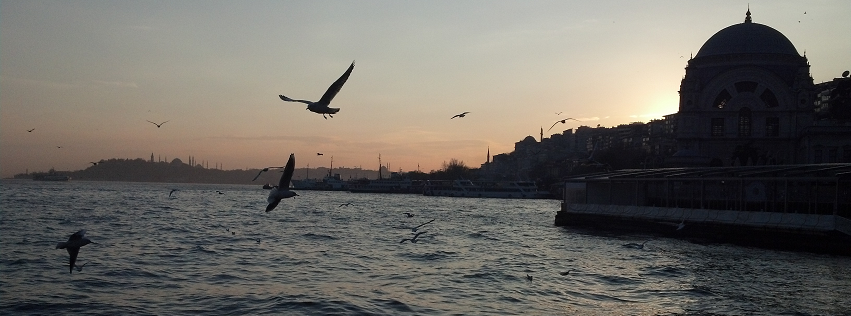
Walking to the edge of the Palace property we took a look down the shore to the Dolmabahçe Mosque, among other skyline elements fading into the sunset.


Sunday, December 30, 2012

Istanbul Diary, Day 6

The day began with cats shopping for hand tools, and then only got more interesting from there.


By the way, you can click to enlarge any of these photos. Blogspot has auto-resized them for easy page loading, but the originals are much larger.

This was the day that we had been looking forward to hungrily - the day we would embark on the famous food tour created by the discerning website editors at Istanbul Eats. Bryan and I took the tram across the Golden Horn to the Karaköy ferry station to await the arrival of our guide.


The ferry pulled up, and we were greeted by the young Turkish gentleman we were expecting, our gustatory guru, Gokcen. Here he is eating ice cream, in a photo previously emailed by our tour operators.


As soon as all 7 guests were assembled, our guide led us off through the dock-side bustle of fisherman and maritime engine repair facilities to this caravanserai, a onetime motel/camel stable where old timey travelers on a budget would stay while on a journey to the big city.


After wandering around the courtyard and appreciating the tumble-down charm of the place, we settled in for some tea. Here, they serve tea in narrow glasses sitting on round saucers. You put your sugar cubes in and mix with the spoon provided. Even the cheapest tea in the most informal places seem to come with these accouterments. It's a must-have for a brisk December morning when sitting in a 500 year old building surrounded by fan belts.


As many Americans observe when traveling, some parts of the world are more awash with the detritus of human civilizations than others. If you found this marble column capital in Maryland, it would probably be in either a museum or an expensive antique store. Here, it serves as a convenient base for mounting some sort of improvised water pump. It's surrounded by empty cardboard boxes and used paper towels. Sic transit gloria mundi. 


As we wandered around the upper level of the building taking more photos, this kitty jumped out of the shadows and into my range of focus. He didn't seem to mind me standing over him at all.


Next up on the tour was a neighborhood lunch spot which, thanks to Gokcen's personal intervention, had agreed to open up for us early and provide us with some traditional Turkish breakfast items.


We started with fresh bread and buffalo milk cream cheese type spread. Also, honey and various jellies. My favorite was the one made with rose petals. For those not mainlining sugar with their breakfast, there was also slabs of feta cheese and salty olives.


Having finished breakfast and thanked the proprietors, we made our way back through the fish market toward the ferries.


Here we are on the ferry between Karaköy and Kadıköy, which, as it turns out, are two entirely different places. You can see the Port of Haydarpaşa, one of Istanbul's major shipping facilities and rail yards, on the opposite shore.


Our first stop on what everyone refers to as The Asian Side was a lively lunch spot that featured toasted bread with spicy tomato paste and grilled meat bits. Everyone else at the table took a small tasting portion as Gokcen described the menu and neighborhood, then stopped eating. As there was plenty of food left, I kept going, continuing even when Gokcen mentioned that he was keeping track of how much each of us what eating. I wasn't sure if that was a joke or some kind of warning about food tour etiquette, but I disregarded it in an case.


Continuing down the street we came to Sekerci Cafer Erol, a famous candy shop that has operated in the city for several decades. In addition to the obligatory Turkish Delight, they had an amazingly meticulous selection of marzipan fruits and vegetables. My favorite was the purple eggplants on the bottom row.


Continuing on a candy kick, we entered the deceptively simple interior of the Bilgeoğlu baklava shop. Unlike the  Greek variety, the baklava here is often dusted with pistachio, which is a key ingredient in sweets over here.


Time to cut through all of that sugar syrup with something sour. Heels up for the pickle shop! We tasted some little cornichons and pickled baby plums, which were...interesting. I also had a few ounces of pickle juice, which Gokcen claimed was wonderful for hangovers. The shop had a squint-inducing spectrum of pickled delights, all prepared with lemon juice rather than vinegar.


Not pausing for a moment, we continued on to a spice shop, which had examples of their wares dried and hanging from the ceiling.


Then it was on to a meat market/deli location where we tasted several different mezes, which are the traditional accompaniment to drinking raki, or, as it's known around here, "Kadıköy lightning." Raki is an anise-flavored spirit popular in Turkey that's often distilled at strengths around 120 proof, so some food is a good idea if you've got a long night ahead of you. 


We didn't actually stop at this seafood shop, but I'm including this photo of blue crabs as a shout out my adopted state of Maryland. Doesn't the crab in the middle look like he wants to give you a big kiss?


And now we relax with a cup of traditional Turkish coffee. You know it's Turkish coffee because it has half an inch of unfiltered sludge at the bottom of the cup. This blackish ooze might look rich in roasty flavor, but you should not under any circumstances be tempted to drink any of it. You'll be sweating coffee grounds for days.


After we finished our coffee, Gokcen tried to show us how to read our fortunes in our cups, in the same way that scary old women in stories read tea leaves. This attempt at divination yielded mixed results, with the most common prediction being that most of us could expect to be traveling soon. As we had all come from various locations between Chicago and Singapore to be on this tour in the first place, this seemed to be a safe prediction.

Little did we know, however, that our amateur coffeemancy would be quickly followed up with rabbit-based  clairvoyance just down the block. The guy holding the board with the colored tabs of paper in the photo below was offering the services of the black and white bunny to tell the future. Gokcen paid for his fortune to be read, which was accomplished by the rabbit being presented with the board and, guided by a supernatural hand, pulling one of the the papers out with its teeth. Upon being presented with the result, Gokcen agreed that it fittingly commented upon his search for an engagement ring for his girlfriend.

The smaller, all-white bunny played no role in this process, other than to look adorable and attract customers. He was, however, for sale.


After all of this excitement, it was time for another glass of tea. We were assured that Turks routinely average 4 cups a day. Given that everyone we saw who was not engaged in manual labor with both hands seemed to be drinking tea at all times, this seemed an extremely conservative estimate. 

Under the glass tabletop we noticed dozens (possibly hundred) of handwritten notes left by previous patrons.  So many so, in fact, that the glass was no longer lying flat on the table, but was raised about a quarter of an inch off of the wood of the table itself. They all seemed to be in Turkish, but Gokcen suggested that many were saucy notes involving young love and its unpredictable discontents.


As we were drinking our tea, a mobile simit vendor walked down the street, yelling out a string of sounds that apparently made only slightly more sense to Turkish speaking listeners than they did to me. Gokcen of course recognized this gibberish-spouting bread seller as a beloved neighborhood character, engaging him in conversation (as far as that was possible) and buying some of his supply. This comic interaction was captured on iPad video by the Singaporean lady sitting next to me. It is still unclear to what extent this particular simit guy was being amusingly eccentric versus full on coo coo crazy pants.


Here's the spot where we stopped, a place that served spicy ground-beef roll-ups. This was described as a great place for eating at the end of a long night of drinking. I don't want to draw too many assumptions about our host's evening activities, but I'm pretty sure he's no stranger to the bottom of a raki bottle.


Apparently tatuni is a recently popular food trend imported from the provinces. Ours was served with a frothy copper mug full of salty watered-down yogurt. The pause that refreshes!


As we were winding up our tour, we stopped at another sidewalk attraction, this one with an open rotisserie oven. I didn't hear exactly what it was we were having (it was near a busy intersection full of traffic and holiday shoppers), but I did notice Gokcen say, twice, "...but you don't have to eat it if you don't want to." Considering we were all pretending to be seasoned international travelers with sophisticated palates, this should have been an alarming allowance, but I let it fly right past me.


And it's a good thing I did. The item in question turned out to be lamb sweetbreads wrapped in intestines and cooked over charcoal. Chopped up with some spices and tomatoes and dropped into a fresh roll, it was actually quite good.

We also stopped at yet a couple more places, including an ice cream shop (although not the one pictured at the top). By that time, however, my camera and my memory-forming capabilities had ceased to function. I was stuffed to the gills, as my father likes to say, and fully satisfied as a tour customer.